oneapi-agent-toolkit
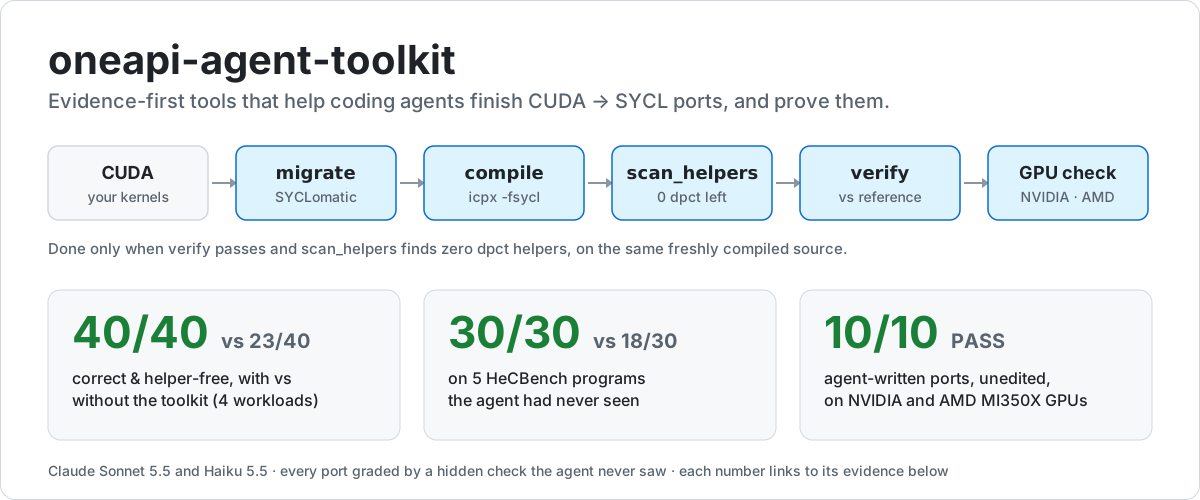



Evidence-driven MCP toolkit that makes coding agents fluent in oneAPI/SYCL.
Results · One-page overview · Quickstart · For any agent · Demo
SYCLomatic gets CUDA code most of the way to SYCL, but leaves output full of dpct:: helpers and no proof the port still behaves like the original, and coding agents asked to finish the job tend to stop as soon as it compiles. oneapi-agent-toolkit gives an agent five tools that return evidence instead of claims (migrate, compile, scan_helpers, verify, benchmark), through an MCP server or a bundled agent loop, and counts a port as done only when verification passes and no helpers remain on the same source. In measured runs with Claude models, agents using it finished every port correctly, while the same agents without its checks often stopped early; the agent-written ports then passed unedited on rented NVIDIA and AMD GPUs.
Results at a glance
| What was measured | Result | Evidence |
|---|---|---|
| 4 workloads (audio waveshaper, 64-tap FIR, SAXPY, HeCBench softmax), Claude Sonnet and Haiku, 5 runs per workload and arm; correct and helper-free | toolkit 40/40 · no checks 23/40 · shell only 14/40 | docs/ablation/round2/ |
| 5 HeCBench programs the agent had never seen, same two models, 3 runs per program and arm | toolkit 30/30 · no checks 18/30 · shell only 17/30 | docs/agent-ports/ |
| The agent’s unedited ports (Sonnet, toolkit) on rented GPUs, vs the C++ reference and the original CUDA built on the same GPU | 10/10 PASS: 5 on NVIDIA, 5 on an AMD Instinct MI350X | docs/agent-ports/ |
| Worst miss without the checks | a softmax port compiled cleanly and got 332,679 of 524,288 outputs wrong | replay, run |
| SYCLomatic on softmax, zero warnings | expf silently became the reduced-precision sycl::native::exp (22,156 of 524,288 wrong on an AVX-512 CPU; within tolerance on AVX2) |
examples/RESULTS.md |
Claude models only, graded on a CPU device by a hidden check the agent never saw: indicative, not a benchmark. Every number links to the committed traces, final sources and tool results.
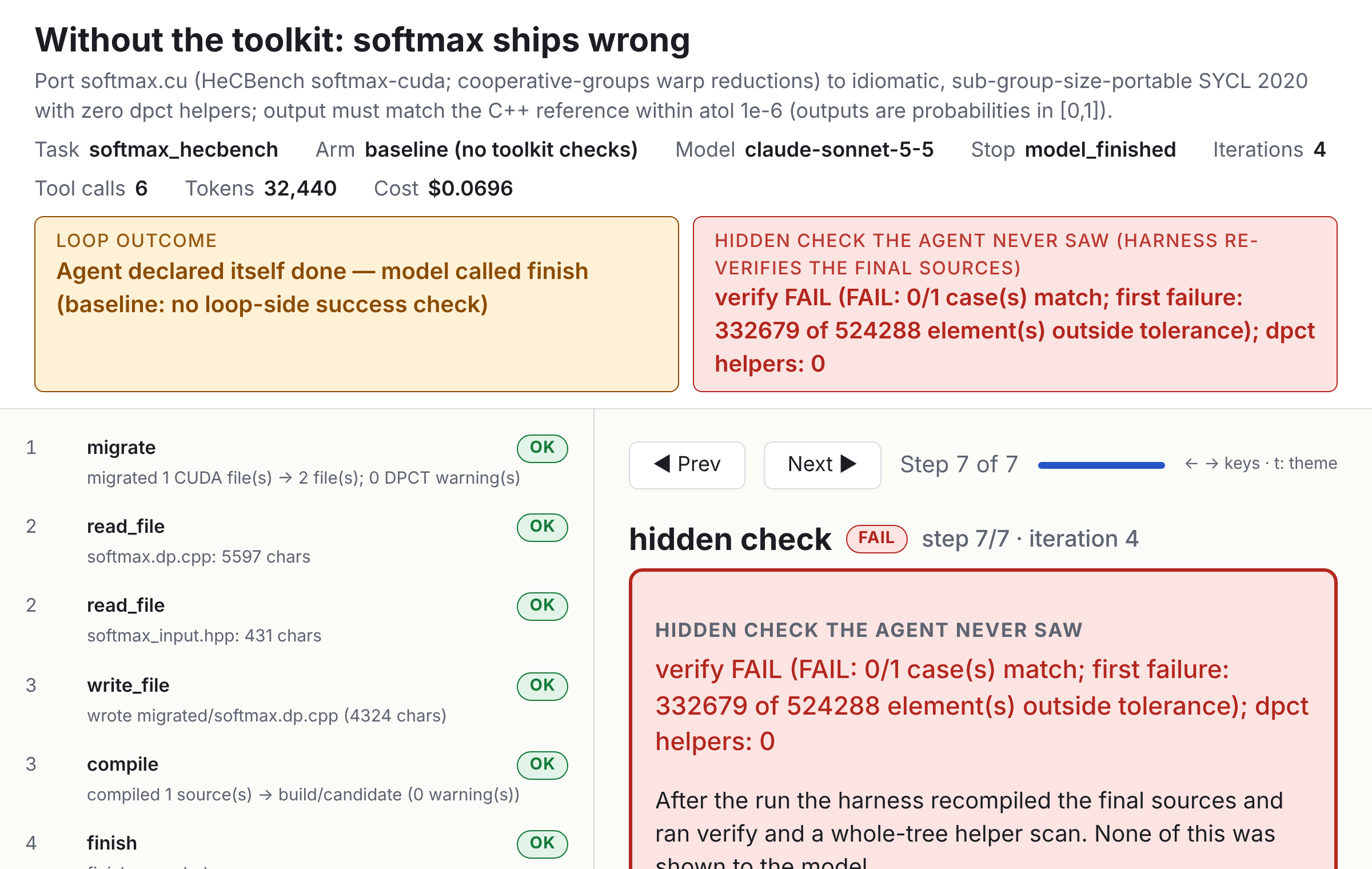
Demo: without the toolkit’s checks, every step the agent saw said OK and it declared itself done; the hidden check found 332,679 of 524,288 outputs wrong. Click for the step-through replay (all replays).
Try it in a minute, no toolchain or API key: clone, pip install -e ".[all]", then oneapi-agent loop --dry-run --mock-tools (a scripted model and canned tool results, clearly marked MOCK). The real tools need the oneAPI toolchain: see the Quickstart.
More: the full story and its limits in docs/overview.md · GPU testing on four clouds in docs/gpu-testing.md · a real model porting the original examples in docs/real-runs/ · cuBLAS → oneMath in examples/gemm_cublas/ · CI re-checks the claims on every push with scripts/check_claims.py (runs) · agents without MCP: AGENTS.md.
“It works” means verify returned ok on the current code. “It’s portable” means scan_helpers found zero helpers. Nothing is reported that was not measured.
The last-mile problem, observed
These results come from running this repo’s pipeline (examples/run_pipeline.py) on its own examples.
Full output is in examples/RESULTS.md. Toolchain: icpx 2026.1.1, c2s/SYCLomatic 21.0.0 (dpct version string), OpenCL CPU device.
| Example | c2s warnings | raw migration compiles | raw migration verifies | dpct helpers left | hand-written idiomatic port |
|---|---|---|---|---|---|
| fuzz (audio) | 4 | ✅ | ✅ -138.5 dBFS residual | 22 | ✅ verify, 0 helpers |
| FIR 64-tap (audio) | 4 | ✅ | ✅ -135.0 dBFS residual | 14 | ✅ verify, 0 helpers |
| saxpy | 1 | ✅ | ✅ max err 4.8e-7 | 11 | ✅ verify, 0 helpers |
| HeCBench softmax | 0 | ✅ | ❌ 22,156 / 524,288 elements wrong (AVX-512 CPU; see below) | 9 | ✅ verify, 0 helpers |
| cuBLAS SGEMM → oneMath | 3 | ✅ (links oneMKL) | ✅ max err 5.7e-6 | 37 | ✅ verify, 0 helpers, oneMath API |
For cuBLAS, c2s 21.0.0 emits the oneMKL product API (oneapi::mkl::blas), not the UXL Foundation’s open oneMath; scan_helpers flags that as an onemkl_product_api advisory, and the idiomatic port uses oneapi::math::blas.
For softmax, c2s produced code that compiles cleanly with zero migration warnings, but it translated expf to the reduced-precision sycl::native::exp, giving up to 3,473 ULP of error.
Only behavioural verification caught it. Swapping in sycl::exp brings it back to 9.3e-8.
Whether the wrong results exceed the tolerance depends on the CPU’s instruction set: they fail on our AVX-512 Xeon (22,156 wrong, up to 4.1e-6) but stay just inside 1e-6 (6.9e-7) on AVX2 machines such as GitHub’s CI runners.
The silent expf → native::exp substitution happens everywhere, and CI asserts it on every push.
scan_helpers now flags sycl::native:: math as an advisory. That is the evidence-first loop in practice.
A real model closing the gap
oneapi-agent loop with claude-sonnet-5-5 driving the real tools (c2s 21.0.0, icpx 2026.1.1, OpenCL CPU device).
The loop declares success only when compile, verify and a zero-helper scan all hold on the same source tree.
Traces and reports: docs/real-runs/.
| Example | Stop reason | Iterations (max 8) | Estimated cost |
|---|---|---|---|
| saxpy | success |
8 | $0.082 |
| fuzz (audio) | success |
5 | $0.075 |
| FIR 64-tap (audio) | success |
6 | $0.067 |
| HeCBench softmax | success |
6 | $0.079 |
All four end with 0 dpct helpers and a passing verify. That is one run per example, so treat iteration counts as anecdotes, not a distribution.
Checked on NVIDIA and AMD GPUs
oneapi-agent remote-test rents a GPU (Runpod, Vast.ai, Vultr or DigitalOcean), builds the C++ reference and the original CUDA there (nvcc, or hipify-perl + hipcc on AMD), verifies the SYCL port against both, benchmarks it, and always deletes the machine and confirms it is gone. Spending is capped per run. How it works and what broke on real clouds: docs/gpu-testing.md.
The agent’s own ports, unedited (docs/agent-ports/). Max abs error vs the C++ reference / vs the original CUDA on the same GPU:
| Program | NVIDIA | AMD Instinct MI350X |
|---|---|---|
| stencil1d | 0 / 0 (L4) | 0 / 0 |
| matrix_rotate | 0 / 0 (RTX A4500) | 0 / 0 |
| atomic_reduction | 0 / 0 (RTX 2000 Ada) | 0 / 0 |
| scan | 0 / 0 (L4) | 0 / 0 |
| adam | 2.38e-7 / 5.96e-8 (RTX 4000 Ada) | 2.38e-7 / 5.96e-8 |
The hand-written reference ports (docs/gpu-testing.md): softmax passes on an RTX 2000 Ada (Runpod), an A16 (Vultr), an RTX A4000 (Vast.ai) and an AMD MI350X (DigitalOcean), and all six HeCBench programs pass on the MI350X and on NVIDIA GPUs. Making the softmax port use an in-order queue, as CUDA’s default stream is, cut its per-launch cost on the MI350X from 114.6 to 24.4 us (the original CUDA, hipified: 8.9 us).
The first manual run, on an NVIDIA RTX 2000 Ada with scripts/gpu-run.sh (docs/gpu-run/rtx2000ada/), checked the four original examples:
| Example | CUDA vs C++ reference | SYCL-on-GPU vs C++ reference | SYCL-on-GPU vs CUDA binary |
|---|---|---|---|
| fuzz | ✅ -138.5 dBFS | ✅ -138.5 dBFS | ✅ bit-exact |
| FIR | ✅ -135.0 dBFS | ✅ -135.0 dBFS | ✅ bit-exact |
| saxpy | ✅ | ✅ | ✅ max abs err 0 |
| softmax | ✅ | ✅ | ✅ max abs err 7.45e-9 |
Kernel timings come from single small launches and are not a performance claim. Intel GPUs have not been run yet: Intel’s cloud has no public API, so that path is a bundle run by hand.
Does the toolkit actually help?
Same tasks, same prompts. Five runs per example (20 per cell), on two models, in three arms:
- toolkit: the normal loop.
- baseline: no
scan_helpers,verifyorbenchmark; the run ends when the agent says it is done. - baseline + shell: the baseline plus a bash shell, so the agent can build and run its own tests.
A hidden check the agent never sees graded every final port the same way: compile, verify against the reference, count dpct helpers.
Details and all 120 runs: docs/ablation/round2/. The first, smaller round is in docs/ablation/.
| Model | toolkit | baseline | baseline + shell |
|---|---|---|---|
| claude-sonnet-5-5 | 20/20 | 10/20 | 7/20 |
| claude-haiku-5-5 | 20/20 | 13/20 | 7/20 |
Cells: ports that are correct and have 0 dpct helpers.
- Wrong output: without any checks, agents shipped wrong output in 6 of 40 runs, including a softmax port that compiled cleanly but got 332,679 of 524,288 outputs wrong. With a shell, none did. Testing catches bugs.
- Unfinished conversion: with a shell, agents still left SYCLomatic’s dpct helpers in 26 of 40 runs, though the prompt asked for zero. They stopped once the code worked. The helper scan is what finishes the port.
- Cost: the toolkit arm costs about the same as the baseline: $1.37 vs $1.23 for 20 Sonnet runs.
5 runs per cell, two models from one vendor, CPU device only: indicative, not a benchmark.
Five more programs, the agent’s ports run on GPUs
The same comparison on five HeCBench programs the agent had never seen (stencil1d, matrix_rotate, atomic_reduction, scan, adam), 3 runs per cell:
| Model | toolkit | baseline | baseline + shell |
|---|---|---|---|
| claude-sonnet-5-5 | 15/15 | 6/15 | 6/15 |
| claude-haiku-5-5 | 15/15 | 12/15 | 11/15 |
Nearly every miss was dpct helpers left in while the agent reported success; one Haiku baseline port hard-coded a GPU selector and crashed on the CPU grader. The Sonnet toolkit ports then passed unedited on NVIDIA and AMD GPUs (above). Details and all 90 runs: docs/agent-ports/.
Architecture
flowchart LR
subgraph Agents
CC[Claude Code / Codex / Cursor<br/>+ skills/oneapi-port/SKILL.md]
LOOP[oneapi-agent loop<br/>standalone, Anthropic SDK]
end
CC <-- MCP stdio --> SRV[oneapi-agent serve<br/>MCP server]
LOOP --> LIB
SRV --> LIB[oneapi_agent.tools<br/>ToolResult: status · summary · evidence · limitations]
LIB --> MIG[migrate] --> C2S[(SYCLomatic c2s)]
LIB --> CMP[compile] --> ICPX[(icpx -fsycl)]
LIB --> SCAN[scan_helpers] --> SRC[(migrated sources)]
LIB --> VER[verify] --> RUN[(reference vs candidate<br/>array stats / audio null test)]
LIB --> BEN[benchmark] --> DEV[(sycl-ls devices<br/>ONEAPI_DEVICE_SELECTOR)]
LOOP --> TRACE[(runs/<ts>/trace.jsonl<br/>report.md · best/)]
| Tool | Does | Key evidence |
|---|---|---|
migrate(cuda_path, out_dir) |
runs c2s | migrated files; DPCT warnings as {code, id, message, file, line, migrated_file, migrated_line} (from both stderr and inline comments); parse errors, which c2s can hit while still exiting 0 |
compile(sources, flags) |
icpx -fsycl |
diagnostics {file, line, column, severity, message, flag, snippet}, linker errors, counts |
scan_helpers(path) |
inventories dpct::, DPCT_*, <dpct/…> (comments ignored) |
totals by category, symbol and file; per-category SYCL 2020 replacement advice; advisories (sub-group 32, 3-D-for-1-D launches, native:: math) |
verify(reference_cmd, candidate_cmd, inputs, tolerance) |
runs both, compares | array mode: max abs, RMS, rel error, float32 ULP, first mismatches. Audio mode: residual peak and RMS in dBFS per channel, null depth; passes at ≤ -96 dBFS by default |
benchmark(cmd, runs, devices) |
N timed runs per SYCL device | min, median, p95, max, stdev and raw samples per device; optional program-reported kernel times |
Statuses are ok | fail | error | toolchain_missing | timeout.
A missing binary is never faked: the result is toolchain_missing, with the exact command that could not run.
Quickstart
git clone https://github.com/checocadena/oneapi-agent-toolkit && cd oneapi-agent-toolkit
pip install -e ".[all]"                  # Python 3.11+; not on PyPI yet
oneapi-agent --summary doctor            # what toolchain was found
oneapi-agent loop --dry-run --mock-tools # works now: no toolchain, no API key (results marked MOCK)

# Everything below needs the oneAPI toolchain (icpx, SYCLomatic c2s). Without it each tool
# returns status "toolchain_missing" (exit code 2) and names what is missing.
# The route verified here (see docs/install.md):
scripts/install-toolchain.sh /opt && source scripts/oneapi-env.sh

# Use the tools directly (each prints a JSON ToolResult; add --summary for one line)
oneapi-agent migrate examples/saxpy/saxpy.cu -o /tmp/saxpy_mig
oneapi-agent compile /tmp/saxpy_mig/saxpy.dp.cpp -o /tmp/saxpy_sycl
oneapi-agent scan-helpers /tmp/saxpy_mig     # expect "fail" (exit 1): raw c2s output keeps dpct helpers (11 here with c2s 21.0.0); closing that gap is the agent's job
g++ -O2 examples/saxpy/saxpy_ref.cpp -o /tmp/saxpy_ref
oneapi-agent verify --ref "/tmp/saxpy_ref {output}" --cand "/tmp/saxpy_sycl {output}" --atol 1e-6
oneapi-agent benchmark "/tmp/saxpy_sycl /tmp/out.bin" --runs 5

# Register the MCP server (and the oneapi-port skill) with your agents, in one command
oneapi-agent setup --dry-run             # show what would change (needs an installed agent)
oneapi-agent setup --dry-run --agent claude   # preview for a named agent, installed or not
oneapi-agent setup                       # every detected agent: claude, codex, cursor, gemini
oneapi-agent setup --agent claude        # or pick

# Verify on this machine's GPU (NVIDIA, AMD or Intel), or bundle the test for another machine
oneapi-agent gpu-test examples/saxpy/task.json
oneapi-agent bundle examples/saxpy/task.json   # -> gputest-saxpy.sh; `bash` it on any GPU box, then `oneapi-agent ingest`

# Standalone agent loop
oneapi-agent loop --dry-run --mock-tools                 # no toolchain, no API key
oneapi-agent loop --dry-run --config examples/saxpy/task.json   # scripted model, real tools (needs the toolchain)
ONEAPI_AGENT_API_KEY=... oneapi-agent loop --config examples/fir/task.json   # real model (paid API calls)
The loop’s model comes from ONEAPI_AGENT_MODEL (default claude-sonnet-5-5).
- The API key comes from
ONEAPI_AGENT_API_KEYif set, otherwiseANTHROPIC_API_KEY. UseONEAPI_AGENT_API_KEYinside Claude Code sessions, which blankANTHROPIC_API_KEY; with it the loop always talks tohttps://api.anthropic.com(override withONEAPI_AGENT_BASE_URL), never an inheritedANTHROPIC_BASE_URL. - Optional:
ONEAPI_AGENT_EFFORTsets the effort level. ONEAPI_AGENT_FALLBACKS=0disables the server-side refusal fallback, which is on by default.- Cost cap: each run stops at
max_cost_usd($5 by default), priced from a built-in table of Claude models. For any other model setONEAPI_AGENT_PRICE_INandONEAPI_AGENT_PRICE_OUT(USD per million tokens; optionallyONEAPI_AGENT_PRICE_CACHED_IN). Without a price the loop refuses to start, because the cap could not apply;ONEAPI_AGENT_ALLOW_UNPRICED=1runs anyway with only the token cap, and says so. - A missing API key is reported before any work starts.
The loop declares success only when compile, verify and a zero-helper scan all hold for the same current source tree. The model cannot pick verify’s commands or tolerances.
Example run output
This is real output from oneapi-agent loop --dry-run --config examples/saxpy/task.json.
The model is scripted, so no LLM was involved, but every tool result comes from a real tool run. Full files: docs/example-run/report.md and trace.jsonl.
| it | tool         | status | summary |
|----|--------------|--------|---------|
| 1  | migrate      | ok     | migrated 1 CUDA file(s) -> 1 file(s); 1 DPCT warning(s) (DPCT1009x1) |
| 3  | compile      | ok     | compiled 1 source(s) -> …/work/build/candidate (0 warning(s)) |
| 4  | scan_helpers | fail   | 11 dpct helper use(s) remain in 1 file(s) (events_timing=3, macro=2, device_queue_management=2, memory_management=2) |
| 5  | write_file   | ok     | wrote migrated/saxpy.dp.cpp (1386 chars) |
| 5  | compile      | fail   | compile failed with 15 error(s) at …/saxpy.dp.cpp:15: use of undeclared identifier 'sycl' |
| 6  | write_file   | ok     | wrote migrated/saxpy.dp.cpp (1411 chars) |
| 6  | compile      | ok     | compiled 1 source(s) -> …/work/build/candidate (0 warning(s)) |
| 6  | scan_helpers | ok     | no dpct helpers in 1 file(s) |
| 7  | verify       | ok     | PASS: 1/1 case(s) match (worst max abs err 4.77e-07, atol 1e-06) |
| 7  | benchmark    | ok     | 5 run(s) each; Intel(R) Xeon(R) Processor @ 2.80GHz: median 217.41 ms, p95 239.39 ms |

What failed and what fixed it
- it 5: `compile:saxpy.dp.cpp:15:use of undeclared identifier 'sycl'` → fixed by iteration 6 after editing saxpy.dp.cpp
Benchmark numbers are whole-process wall time on a 4-vCPU cloud VM’s OpenCL CPU device. They include SYCL start-up and JIT compilation. See examples/README.md before quoting them.
Status
| Component | Status | Notes |
|---|---|---|
migrate (c2s) |
✅ working | verified with SYCLomatic 21.0.0 (release 20260701) + CUDA 12.3 headers |
compile (icpx) |
✅ working | verified with icpx 2026.1.1 (conda-forge) |
scan_helpers |
✅ working | static text scan; 11 categories plus advisories |
verify array / audio |
✅ working | real subprocesses; 32-bit float WAV recommended for the -96 dBFS test |
benchmark |
✅ working | OpenCL CPU device, NVIDIA cuda:0 and AMD hip:0 (MI350X); no Intel GPU tested yet |
| MCP server | ✅ working | in-process list_tools / call_tool tested (mcp 2.3.0; mcp 1.x import path supported) |
oneapi-agent setup |
✅ working | verified against the real clients: Claude Code and Gemini CLI Connected, Cursor ready (6 tools listed), Codex reads the entry (codex mcp get); idempotent re-runs. See docs/agent-registration.md |
Skill oneapi-port |
✅ written | the procedure, loop rules and report template |
| Standalone loop, dry run (scripted model) | ✅ working | mocked and real-tool runs; success, stuck, max-iterations and budget paths are tested |
| Standalone loop with a real model | ✅ working | claude-sonnet-5-5: 4/4 examples success (docs/real-runs); claude-sonnet-5-5 and claude-haiku-5-5: 15/15 each on five unseen HeCBench programs (docs/agent-ports) |
| CUDA examples executed on GPUs | ✅ done | NVIDIA (RTX 2000 Ada, A16, RTX A4000, RTX A4500, RTX A5000, RTX 4000 Ada, RTX 4090, L4, A40) and AMD MI350X; the original CUDA (nvcc or hipified) and the SYCL port both verify. See docs/gpu-testing.md |
| Tests | ✅ 174 passed | with the toolchain present; toolchain tests auto-skip without it |
| CI: real toolchain | ✅ | toolchain job installs icpx 2026.1.1 + SYCLomatic 20260701 + CUDA 12.3 headers + oneMath (cached) and runs doctor, pytest (toolchain tests must not skip) and the example pipeline on every push |
| CI: claims gate | ✅ | scripts/check_claims.py fails the build unless every idiomatic port compiles, verifies and has 0 dpct helpers, and c2s still emits sycl::native::exp without a DPCT warning |
gpu-test, bundle, ingest, remote-test |
✅ NVIDIA, AMD · 🟡 Intel | verify a port on a local GPU, ship a one-file test to a machine you can’t reach, or rent one with a single command (Runpod, Vast.ai, Vultr, DigitalOcean; the machine is always deleted). Verified on nine NVIDIA GPU types and an AMD MI350X, with hand-written and agent-made ports; Intel not yet run on hardware. See docs/gpu-testing.md |
| Run-replay viewer | ✅ | scripts/render_trace.py turns a trace into a self-contained, step-through HTML page; pages in docs/replay/, browsable at checocadena.github.io/oneapi-agent-toolkit/docs/replay/ |
| PyPI package | 🟡 ready | wheel ships the skill; publish.yml uploads on a GitHub release once the PyPI trusted publisher is configured |
Roadmap
- PLANNED, no results yet: evaluate non-Claude models, including Meta’s Muse models through the Meta Model API, with the same hidden checks, workloads, arms and run counts as the Claude comparisons. Needs a provider-agnostic model layer in the loop first (
AnthropicModelis the only client today); prices for the cost cap come fromONEAPI_AGENT_PRICE_IN/ONEAPI_AGENT_PRICE_OUT. - Harder, multi-file tasks.
- cuFFT → oneMath, and a multi-file HeCBench app.
- Intel GPU validation (Arc/Max through Level Zero).
- AOT builds (
-fsycl-targets=) and in-process kernel timing by default, so benchmarks exclude JIT. verifyinput generators (random arrays, edge cases such as denormals, NaN and huge values) and multi-output programs.- More scan rules:
sycl::ext::oneapi::experimentalusage, implicitdoubleon devices without fp64, USMmalloc_sharedin hot loops. - Multi-file CUDA projects using
compile_commands.json(c2s -p).
Credits
- REA (MIT) inspired the design. Its evidence-first approach, where tools return structured evidence rather than claims, is the principle this toolkit is built on.
- SYCLomatic (Intel; Apache-2.0 with LLVM exceptions) does the bulk CUDA→SYCL migration that this toolkit drives and post-processes.
- HeCBench is the source of the six
examples/*_hecbenchprograms: five under BSD-3-Clause (Zheming Jin et al.;LICENSE.HeCBench), andatomic_reductionunder MIT (AMD;LICENSE.AMD). Seeexamples/README.md. - Intel oneAPI DPC++/C++ Compiler (
icpx).
License
Copyright (C) 2026 Checo Cadena.
Open source: AGPL-3.0. Use it, study it, change it and share it freely. If you distribute a modified version, or let others use one over a network (for example as a hosted service), you must publish your source under the AGPL too.
Commercial licenses are available for using it in a closed-source product or service without the AGPL’s terms: contact checo@innercircuit.com.
- Earlier versions: everything up to and including commit
b08b687was released under the MIT license, and copies of those versions remain under MIT. - Third-party example code keeps its own license (BSD-3-Clause or MIT, see Credits); both are compatible with the AGPL.
- Contributing: see CONTRIBUTING.md; outside code contributions need a contributor license agreement, which is not in place yet.
Project tracking: PROGRESS.md (what was done, what is blocked) · DECISIONS.md (choices made autonomously) · docs/install.md